

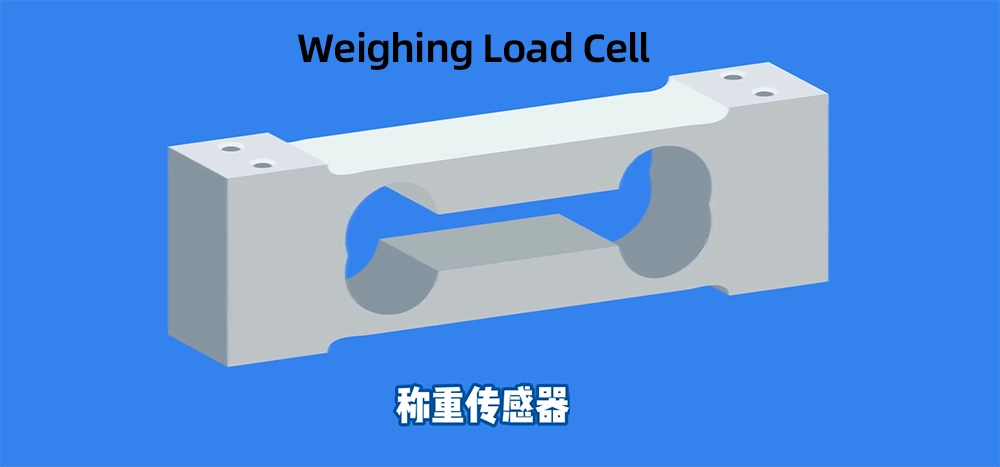
1. Overall Conversion Logic: Convert Weight Force into Readable Electrical Signals 整体转换逻辑:将重量外力转化为设备可读电信号
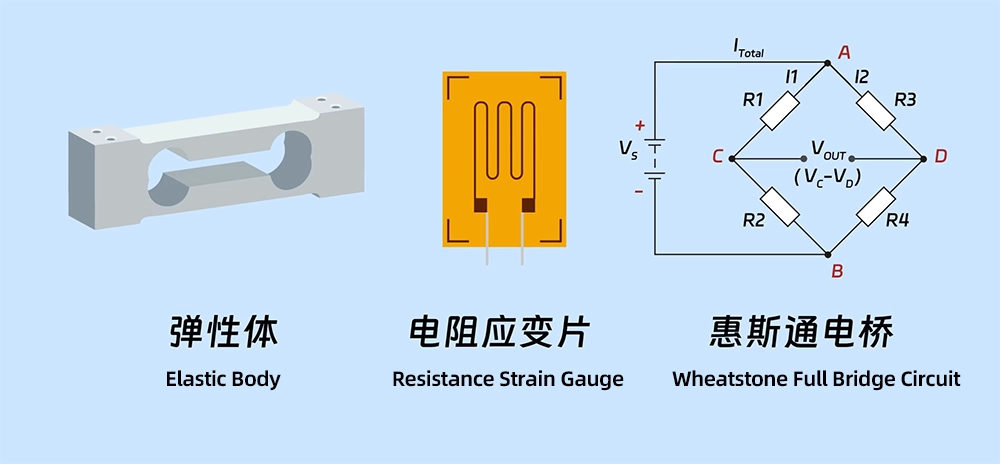
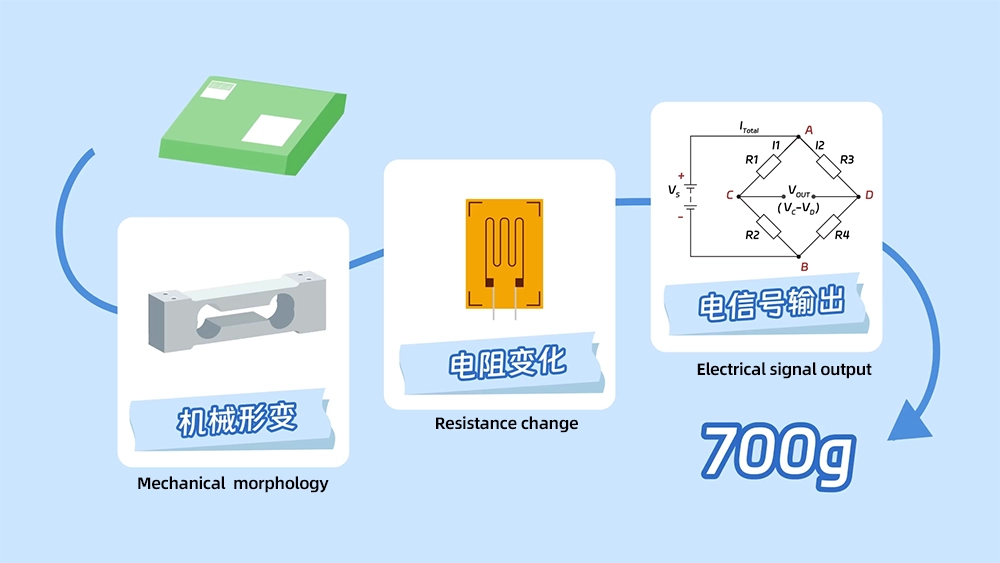
A complete weighing system realizes multi-stage conversion: external force → mechanical deformation → resistance variation → voltage signal → standard industrial signal. The core components include elastic body, resistance strain gauge and Wheatstone bridge circuit.
一套完整称重系统完成多级转换:外力→机械形变→电阻变化→电压信号→标准工业信号,核心三大部件为弹性体、电阻应变片、惠斯通电桥。
Step 1: Elastic Body Deforms Under Force to Change Strain Gauge Resistance 第一步:外力令弹性体形变,应变片电阻随之改变
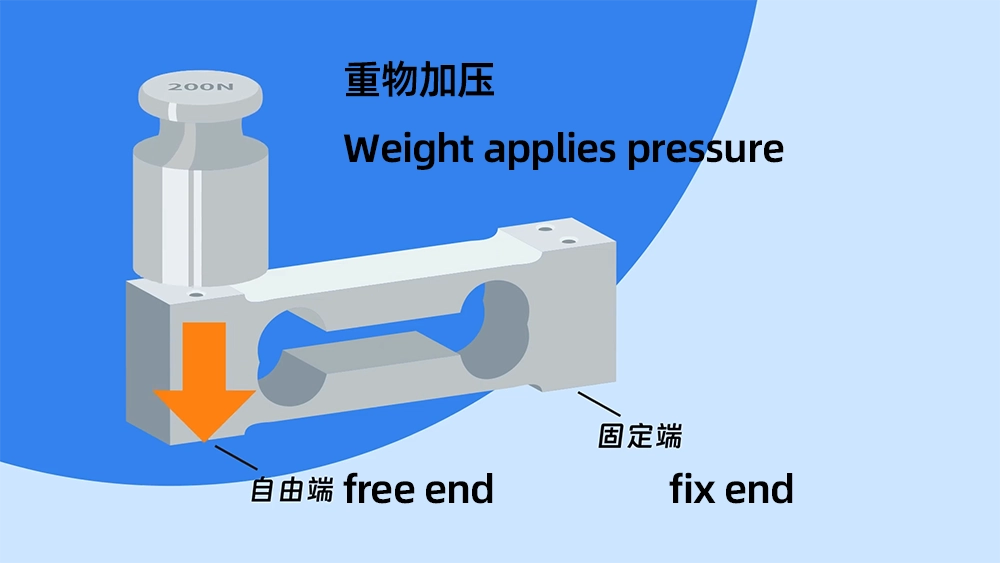
The elastic body is the metal main body of the load cell. When weight applies pressure, the metal produces micro-scale tiny deformation. Multiple resistance strain gauges are pasted on the surface of the elastic body and stretch or compress synchronously with the metal.
弹性体是传感器金属主体,重物施压时金属产生微米级微小形变;弹性体外表面粘贴多枚电阻应变片,会跟随金属同步拉伸或压缩。
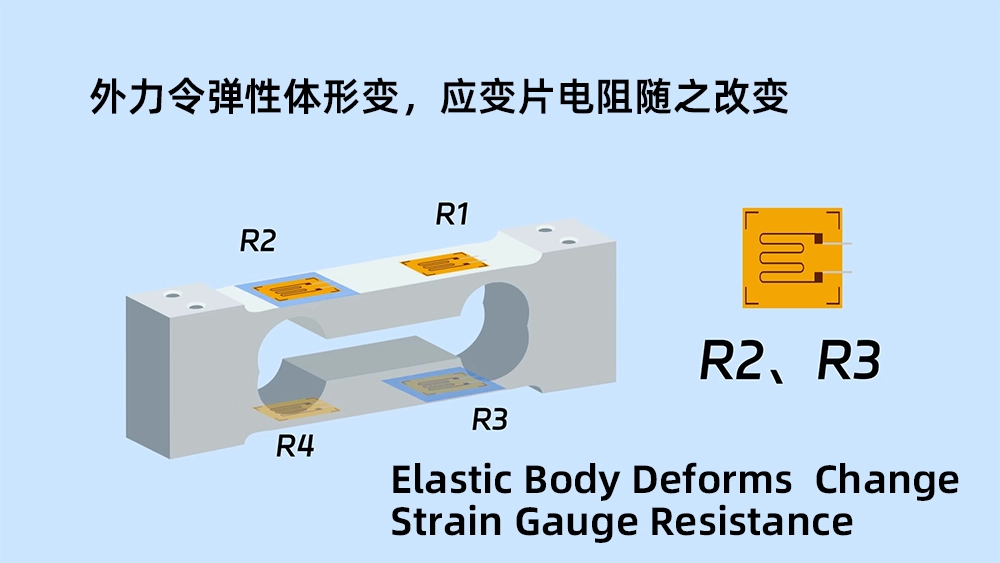
Fixed resistance variation rules 电阻变化固定规律:
- Tension zone: The strain gauge stretches, the metal wire becomes longer and thinner, so resistance rises. 拉伸区:应变片被拉长,金属丝变长变细,电阻数值增大;
- Compression zone: The strain gauge shrinks under squeeze, the metal wire becomes shorter and thicker, so resistance drops. 压缩区:应变片受挤压收缩,金属丝变短变粗,电阻数值减小。
Step 2: Wheatstone Bridge Converts Tiny Resistance Difference into Voltage Signal 第二步:惠斯通电桥将微弱电阻差值转化为电压信号
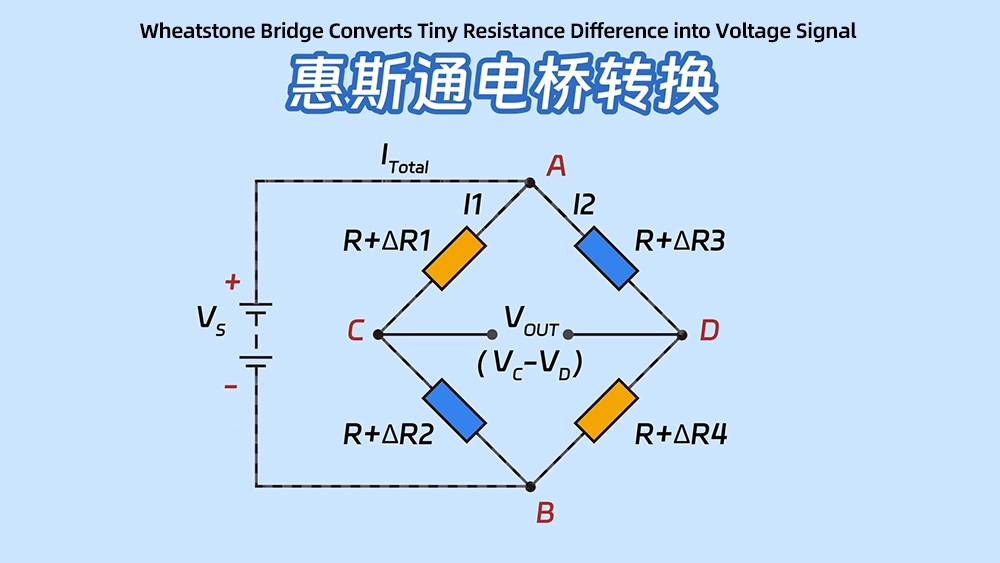
Four strain gauges are symmetrically connected to the full Wheatstone bridge in a “2 tension + 2 compression” layout.
四片应变片以「两拉两压」对称结构接入全桥惠斯通电桥电路。
Two core functions of the bridge 电桥两大核心作用:
- Amplify weak signals: Resistance changes of tension and compression gauges superimpose oppositely, doubling output voltage and greatly improving weighing sensitivity. 放大微弱信号:拉伸、压缩应变片的电阻变化反向叠加,输出电压幅度翻倍,大幅提升检测灵敏度;
- Offset temperature interference: Four strain gauges share the same ambient temperature, so resistance drift caused by temperature cancels each other out and reduces weighing error. 抵消温度干扰:四片应变片处于相同环境温度,温度引发的电阻漂移相互抵消,降低称重误差。
Under external force, the circuit outputs tiny differential voltage \(V_{OUT}\), the original electrical signal carrying weight data.
在外力作用下,电路两端输出微小差分电压\(V_{OUT}\),这是承载重量信息的原始电信号。
Step 3: Transmitter Conditions Signals to Output Standard Industrial Signals 第三步:变送器调理信号,输出标准工业电信号
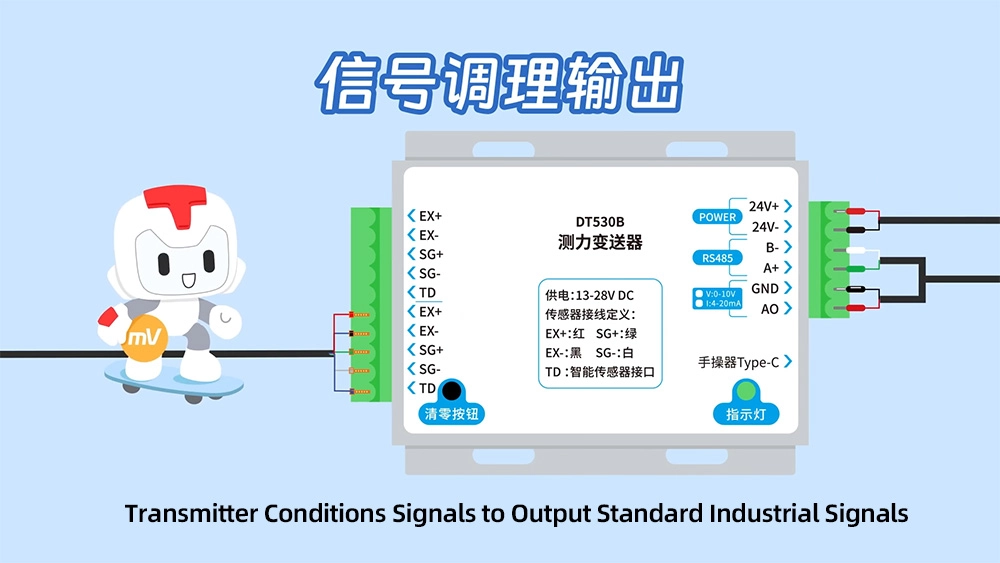
The raw differential voltage from load cells is too weak for direct reading by PLC or industrial controllers, so a force transmitter is required for signal processing.
传感器原生差分电压幅值极小,无法直接被 PLC、工控设备读取,需搭配测力变送器完成信号处理。
Full processing flow of transmitter 变送器完整处理流程:
Differential voltage input → electrical isolation → signal amplification → noise filtering → A/D analog-to-digital conversion
差分电压输入 → 电气隔离 → 信号放大 → 杂波滤波 → A/D 模数转换
After processing, the transmitter outputs standardized industrial signals, common types as follows:
信号处理完成后,变送器对外输出标准化工业信号,常见类型分为:
- Analog signals 模拟量:0~10V voltage, 4~20mA current 0~10V 电压、4~20mA 电流;
- Digital signals 数字量:RS485 communication signal RS485 通讯信号。
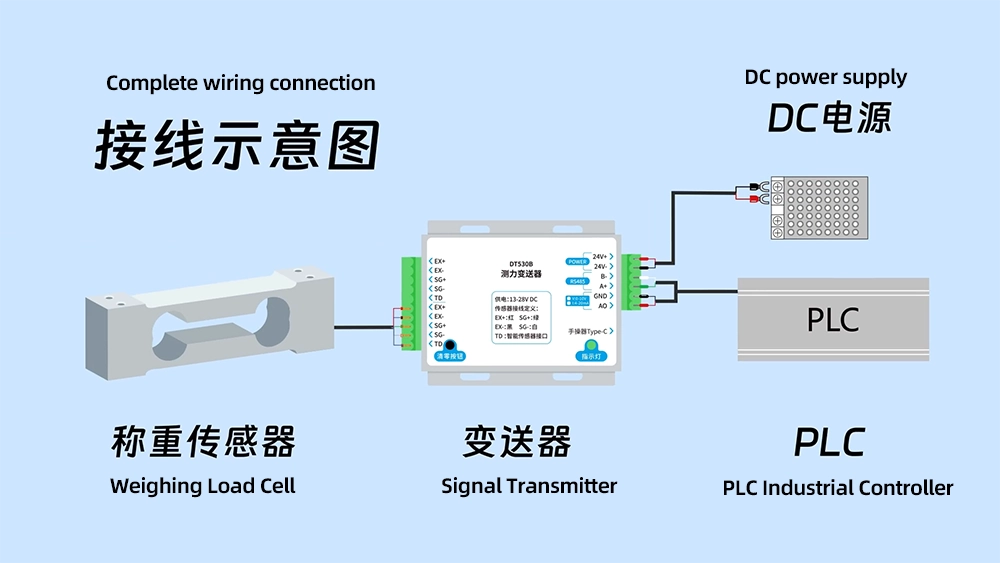
Complete wiring connection 整套接线链路:
Weighing load cell → force transmitter → DC power supply → PLC industrial controller
称重传感器 → 测力变送器 → 直流供电电源 → PLC 工控设备,实现重量数据采集。
2. Core Nature of Weighing Load Cell 称重传感器核心本质
The weighing load cell is a multi-stage energy conversion component, with the conversion chain as below:
称重传感器是多级能量转换元器件,完整能量转换链路:
External force (weight) → metal elastic deformation → strain gauge resistance variation → differential voltage → standard digital/analog electrical signal
外力(重量)→ 金属弹性形变 → 应变片电阻变化 → 差分电压 → 标准数字 / 模拟电信号
As the core sensing component of industrial and commercial weighing equipment, it is widely applied in weight detection and force measurement scenarios.
作为工业、商用称重设备核心感知元件,广泛应用于重量检测、力值测量场景。